Written by the Dyallok Hotel & Resort team — Umapur, Bhagwanpur, Kaimur · Updated September 2026
| Quick answer
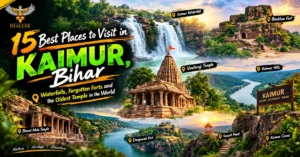
Kaimur district in southwest Bihar holds the world’s oldest functioning temple, an 80-metre waterfall, India’s least-visited crocodile habitat, an 11th-century Shiva temple built in the Khajuraho style, and prehistoric rock paintings that have never been properly catalogued. Almost everything worth seeing sits within 45 km of Bhabua, the district headquarters, which makes the whole district a comfortable two-day trip. Best time to visit: October to March. Nearest railhead is Bhabua Road (Mohania); nearest airports are Gaya and Varanasi. |
Bihar tourism gets summarised as Bodh Gaya, Nalanda and Rajgir. Kaimur rarely enters the conversation at all — and there is a specific historical reason for that, not just bad luck.
Alexander Cunningham, the first Director-General of the Archaeological Survey of India, surveyed enormous stretches of the subcontinent in the nineteenth century. Sites he documented went on to attract scholars, funding and eventually tourists. Kaimur he largely skipped. Rohtasgarh Fort appears in the Ain-i-Akbari and in Ferishta’s chronicles; Shergarh Fort, barely 40 km away, appears in almost nothing. The rock shelters in these hills remain, by the admission of regional archaeologists, essentially undocumented.
So the district’s obscurity is an accident of nineteenth-century paperwork, not a verdict on what is here. We run a hotel on the Mundeshwari route and send guests out to these places every week. Here is what is genuinely worth your time.
Kaimur at a Glance
| Place | From Bhabua | Best for |
| Maa Mundeshwari Temple | 10–12 km | Heritage, darshan |
| Harsu Brahma Temple, Chainpur | ~10 km | Architecture |
| Chainpur Fort | 11 km | History |
| Tomb of Bakhtiyar Khan | ~16 km | Indo-Islamic architecture |
| Telhar Kund | 31–32 km | Waterfall, picnic |
| Karamchat Dam (Durgavati Reservoir) | ~35 km | Scenery, photography |
| Karkatgarh Waterfall | ~42 km | Crocodiles, forest |
| Kaimur Wildlife Sanctuary | 35–50 km | Wildlife, birding |
| Durauli temples | 8 km from Ramgarh | Chero-era temples |
| Chorghatia, Adhaura | Adhaura block | Offbeat waterfall |
Temples and Heritage
1. Maa Mundeshwari Temple, Ramgarh
The headline attraction and the reason most visitors come to Kaimur at all. Standing at 608 feet on a hilltop in Ramgarh village, it is widely regarded as the oldest functioning Hindu temple in the world — worship here has never been interrupted. The octagonal plan is rare, and the temple is considered the earliest surviving example of Nagara architecture in Bihar. We have written a full visitor guide covering timings, the 500-step climb and the dating debate: Maa Mundeshwari Temple Guide.
2. Harsu Brahma Temple, Chainpur
This is the site that surprises visitors most, and almost nobody outside the district knows it exists. About 10 km southwest of Bhabua on the Bhabua–Chainpur road, it is a Shiva temple with an octagonal base and shikhara that regional sources compare directly to the Kandariya Mahadev temple at Khajuraho. The garbhagriha is carved from a single rock — genuinely fine craftsmanship.
It is attributed to the 11th century and to the Chandela ruler Vidyadhara. Four kunds were built at the four corners — Dhruv, Rudra, Brahma and Vishnu — of which two survive. The shrine is associated with Harshu Pandey, a priest of Raja Salivahana who, according to local tradition, ended his life in protest in 1427 AD after his house was demolished. Devotees still come here believing the shrine relieves affliction by spirits, and it remains an actively visited place rather than a monument.
3. Chainpur Fort
Eleven kilometres west of Bhabua, the fort is believed to have been the seat of the Sakawar Rajput family and is attributed to Raja Salivahana. Whether it dates to the Suri or the Akbar period has never been settled. The Harsu Brahma shrine sits inside the ramparts, so the two are visited together.
4. Tomb of Bakhtiyar Khan
A monument of national importance under the ASI, standing on the banks of the Kuah river near Chainpur. The style places it in the same period as the Tomb of Sher Shah Suri at Sasaram, though the inscription carries no construction date. The structure is octagonal, the enclosure runs roughly 88 by 70 metres, the roof verandah carries 24 small domes, and the chamber holds around 30 graves besides Bakhtiyar Khan’s own.
It sits roughly 18 km from Mundeshwari and about a kilometre from Harsu Brahma temple, which makes a three-site heritage morning entirely practical.
5. Durauli Temples
Eight kilometres northeast of Ramgarh, this village holds two old temples built by the Cheros — the aboriginal community that once held power across these hills and whose Shakti worship shaped Mundeshwari itself. Small, unrestored, and of real interest if you have already done the main sites.
Waterfalls and Water
6. Karkatgarh Waterfall
About 42 km from Bhabua in Chainpur block, on the Karmanasa river close to the Uttar Pradesh border. The fall is roughly 300 feet wide and 100 feet high, set in dense forest.
Its history is better than its current reputation. Mughal rulers and later British officials came here to hunt crocodiles; a dak bungalow was built overlooking the fall, and the British officer Henry Ramsay described it as the finest fall he had seen, surrounded by beautiful scenery. It now falls within Kaimur Wildlife Sanctuary, hunting is prohibited, and since 2019 the Bihar government has been developing it as a crocodile conservation reserve and eco-tourism site.
7. Karkatgarh Crocodile Habitat
The rocky river pools here support mugger crocodiles in genuinely wild conditions — no enclosure, no feeding platform. Take a local guide, keep a sensible distance, and go post-monsoon when water levels are high and animals are active. There is almost nowhere else in eastern India where you can see this so easily and so unmanaged.
8. Telhar Kund
Around 31–32 km from Bhabua and 47 km from Mohania, on the Rohtas plateau near the Durgavati river. The fall drops roughly 80 metres into a pool at the base that draws picnicking families through the cooler months. It sits about 28 km from Mundeshwari, so it pairs naturally with a temple visit. The National Hydro Electric Power Corporation has studied the site for hydropower potential, which tells you something about the volume of water moving through it in season.
9. Karamchat Dam and Durgavati Reservoir
Close to Telhar, a reservoir ringed by hills and forest. There is nothing to do here in the organised-attraction sense, which is exactly the appeal — it is the best place in the district for an unhurried afternoon and the strongest light for photography around sunset.
10. Chorghatia, Adhaura
The district administration describes this village in Adhaura block as an excellent beauty spot with a waterfall set in fine scenery. Adhaura is the remote, high block of the district, roads are poorer, and you should not attempt it in monsoon or without a local driver. For travellers who actively want somewhere unvisited, this is it.
Wildlife and Prehistory
11. Kaimur Wildlife Sanctuary
Established in 1979 and the largest protected area in Bihar, spread over more than 1,300 square kilometres across Kaimur and Rohtas districts. The forest is a mix of sal, bamboo and mixed deciduous cover. Leopards, deer, wild boar and a strong resident bird population are present, and migratory species arrive in winter.
Manage expectations: this is not a safari park. There are no guaranteed sightings and infrastructure is limited. What it offers is genuine forest, very few people, and excellent birding between November and February.
12. Prehistoric Rock Shelters and Cave Paintings
Rock paintings from the stone age survive at several sites in the Kaimur hills, with a concentration recorded around Karar village. Photographic records exist in regional collections, but the sites themselves have never been systematically catalogued or protected. If you visit, treat them as the fragile, unguarded archaeology they are — look, photograph, touch nothing.
13. Shergarh Fort
An isolated fort in forest country, historically overshadowed by Rohtasgarh and, as noted above, almost entirely absent from the written record. Reaching it takes effort and local guidance. For travellers who value ruins without ticket counters, it is the most rewarding thing in the district.
Two Nearby Additions Worth the Drive
- Rohtasgarh Fort — a vast hilltop fort with gateways, temples and stepwells in neighbouring Rohtas district. Requires a trek.
- Dhuan Kund and Tutla Bhawani — waterfalls near Sasaram, the second paired with a well-known shrine. Both are comfortable day additions from a Kaimur base.
A Practical Two-Day Itinerary
| When | Plan |
| Day 1, early morning | Mundeshwari darshan at sunrise — beat the crowd and the heat |
| Day 1, late morning | Harsu Brahma Temple, Chainpur Fort and the Tomb of Bakhtiyar Khan (all within 1–2 km of each other) |
| Day 1, afternoon | Karkatgarh Waterfall and the crocodile stretch; take a guide |
| Day 1, evening | Return to Bhagwanpur or Bhabua for the night |
| Day 2, morning | Telhar Kund |
| Day 2, afternoon | Karamchat Dam, then onward to Varanasi, Sasaram or Patna |
When to Go, and What to Bring
October to March, without serious competition. The weather suits both the Mundeshwari climb and long drives, and post-monsoon water levels keep the waterfalls impressive well into December. Monsoon makes the falls spectacular but the forest roads unreliable. Summer is workable only with dawn starts.
| Things guests consistently wish they had known
Carry your own drinking water everywhere. This region has real water scarcity and almost none of these sites have facilities. There is no reliable food at the waterfall or forest sites. Eat before you leave or carry a packed meal. Mobile signal drops in Adhaura block and inside the sanctuary. Download offline maps. Hire a driver who knows these roads rather than self-navigating. Several of these turnoffs are unmarked. Do not swim below the falls in monsoon, regardless of how calm the pool looks. |
Getting Around Kaimur
Bhabua Road (station code BBU) at Mohania is the district’s railhead, on the Grand Chord line with over 70 trains passing daily. Gaya and Varanasi are the nearest airports. Once you arrive, though, public transport between these sites barely exists — autos serve the Bhabua–Chainpur–Mundeshwari corridor and little else.
A car with a driver for two days is the only sensible way to cover the district. Families and groups coming in from Varanasi, Patna or Ayodhya can compare all-inclusive outstation and Tempo Traveller fares on InDiscover, which maps these pilgrimage and highway corridors with realistic drive times rather than optimistic ones.
Where to Stay
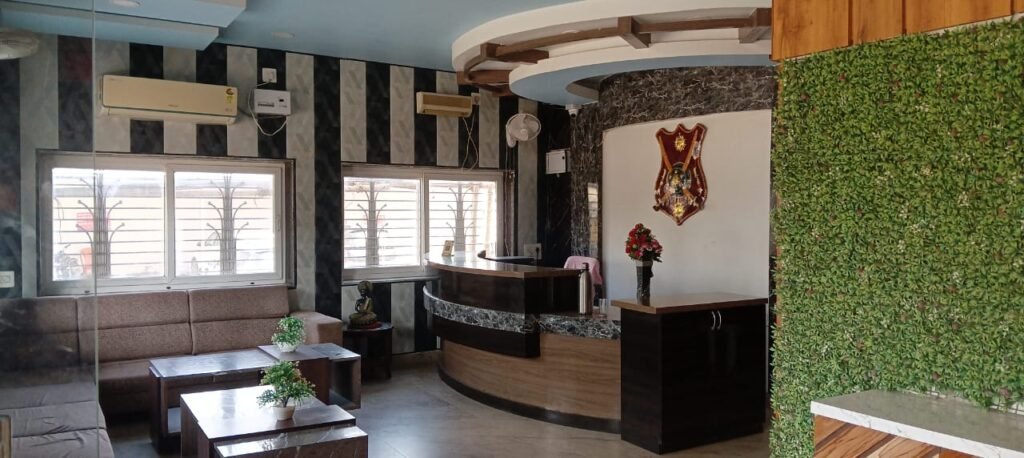
Bhabua town and Bhagwanpur are the two practical bases; there is no worthwhile accommodation at the waterfalls or inside the sanctuary. Our own property, Dyallok Hotel & Resort, sits in Umapur, Bhagwanpur, about 6.5 km from Mundeshwari, with AC rooms from ₹1,500, an on-site restaurant and a banquet hall. Being on the temple side of the district shortens every drive on the itinerary above. See room options and rates, our guide to choosing a hotel on this route, or the tourism places we help guests plan around.
Frequently Asked Questions
What is Kaimur famous for?
Maa Mundeshwari Temple, widely described as the world’s oldest functioning temple, along with the Kaimur hill waterfalls — Karkatgarh and Telhar Kund — and Kaimur Wildlife Sanctuary, the largest protected forest in Bihar.
How many days do you need in Kaimur?
Two days covers the temples, both major waterfalls and the dam comfortably. One day is enough only for Mundeshwari and the Chainpur heritage cluster.
What is the best time to visit Kaimur?
October to March. Post-monsoon months give the best waterfall flow alongside manageable weather and road conditions.
Is Karkatgarh waterfall safe to visit?
It is a wild crocodile habitat inside a sanctuary. Visit with a local guide, stay back from the water’s edge, and do not enter the river.
How do I reach Kaimur?
Bhabua Road (Mohania) is the nearest railway station, on the Delhi–Howrah Grand Chord. Gaya and Varanasi are the nearest airports. NH-30 connects the district to Patna via Arrah.
Are there hotels near the Kaimur waterfalls?
No. There is no accommodation at Karkatgarh or Telhar Kund. Stay in Bhabua or Bhagwanpur and drive out for the day.
| About the author
Written by the on-ground team at Dyallok Hotel & Resort, Umapur, Bhagwanpur, Kaimur — operating on the Mundeshwari route since 2012 (formerly Anand Lok). Distances, road conditions and seasonal notes reflect what we observe and what guests report back to us year-round. Historical and administrative details are drawn from the Kaimur District Administration portal (kaimur.nic.in), Bihar Tourism, Archaeological Survey of India records and regional archaeological writing on the Kaimur hills. Digital strategy, technical SEO and content structure by Synor — synor.in |
Planning a Kaimur trip? Call +91-9973426835 or email dyallok2021@gmail.com — we help guests build two-day district itineraries at no charge.